

I finished Bridge to Haven on a Sunday afternoon in July 2025, three weeks after I opened it, and then I sat in the green chair for a while without reaching for anything else. That is not how I usually end a book. Usually I close it, write the date on the notebook page, and have the next one picked out before supper. This one asked me to sit still. Francine Rivers wrote a long novel, 480 pages in the Tyndale paperback, and she spent those pages slowly on purpose. I have kept four other novels on the hall bookcase these past few years, and this is the only one I was still turning over a week later.
So this is not the tidy review. The tidy version is easy: a well loved novel, a good rating, hand it to a friend and move on. The honest version has three caveats in it that nobody prints on the back cover, and I would rather you heard them from me now than found them out at page two hundred. I will not tell you what happens. I never do. Not the ending, not the turn in the middle, not who ends up where. What I can tell you is how the book read, how long it took, what it asks of a reader, and who I would and would not hand it to.
The Quick Verdict
A long, serious novel about grace and consequences, written for adults. Not a mystery, not a fast read, and not a book to put in a young teenager's hands.
Amazon Check Today's Price →480 Pages That Earned Their Three Weeks
This is the Tyndale paperback, the reprint edition, the one on my hall bookcase. If you want a long story with weight to it, this is the copy I read and the one I would buy again.
Amazon Check Today's Price on Amazon →How I've Used It: Three Weeks, One Paperback, One Notebook
I bought the paperback. I have never owned a reading device of any kind and I do not intend to start at sixty-six, so the book came as paper and stayed as paper. It arrived, I dated a fresh page in the notebook that lives on the side table, and I started it on a Tuesday evening after supper with Glenn in the other chair not reading a novel, as usual. Three weeks later I wrote the closing date. That makes it the longest of the five I have kept. The others took ten days apiece, and one of them took two nights.
Three weeks is not a complaint. It is information, and it is the first thing I would want to know if a friend handed me a book this size. Some novels are long because nobody made the author cut. This one is long because it follows a life across a stretch of years, from a small town to a very different world, and the length is doing work. But you should know what you are agreeing to when you carry it home. It does not move like a suspense novel. It does not even move like a mystery. It moves the way a good biography moves, at the pace of a person's life.
I read it mostly in the evenings, with two long Sunday afternoons in it, which is my ordinary pace of about one novel every ten days. This one ran past that because there were nights I read four pages and set it down to think, and I am not a reader who does that. My notebook page for this book has more written on it than any page in the last three years. That is the closest thing to a recommendation I know how to give.

What the Book Is, and What It Is Not
The listing tells you the shape of it, and I will stay inside that. It is set partly in 1950s Hollywood and partly in a town called Haven. It follows Abra, who is also known as Lena Scott, and it brings in Pastor Ezekiel Freeman, called Zeke, and his son Joshua. That is as far as I will go, because a plot laid out in a review is a book half read. If you want somebody to tell you how it ends, you will have to ask somebody else.
What it is not: it is not a mystery, and that is the thing readers most often get wrong. My book group reads a good deal of mystery and suspense. Four of the five novels I have kept involve a case of some kind, a detective, a search dog, a woman on the run. Bridge to Haven is none of that. There is no case to solve and no culprit to name. If you come to it expecting to be kept guessing, you will spend the first hundred pages waiting for something that is not coming, and you will blame the book for it. Come to it expecting a long story about a life and its choices, and you will be in the right frame of mind.
It is also a standalone, which mattered to me more than I expected. I have a bad habit of starting in the middle of a series and having to go back for the first one. Here there is no book two, no waiting, no list to keep. You finish it and you are finished. For a woman with three series going at once, that was a relief.
Three weeks is not a complaint. It is information, and it is the first thing I would want to know if a friend handed me a book this size.
The Length, in Plain Numbers
480 pages. Tyndale Fiction, reprint edition, April 2015, in English. The book measures 5.9 by 1.3 by 8.8 inches and weighs 2.31 pounds. I put those numbers in because I wish somebody had put them in front of me. Two and a third pounds is a real weight to hold up in a chair for three weeks, and if your hands are like mine at sixty-six, that is not nothing. I propped it on a cushion more than once and I am not ashamed of it.
The thickness is not padding. A story about consequences has to let the consequences arrive, and consequences take time. The first third sets a life in motion and I moved through it easily. The middle is where a reader's patience gets tested, and mine was tested somewhere around the two hundred page mark, not because anything was wrong, but because I wanted to know how it turned out and the book would not hurry for me. It knows what it is doing. That does not make the waiting shorter.
The last third was faster. I read the final hundred and fifty pages in three sittings, which for me is quick. That is the pattern I would tell a friend to expect: a steady start, a long middle, a quick finish. If you can give a book three weeks, this is a fair trade. If you read in twenty minute snatches on a lunch break, this will take you two months and you may lose the thread of it, and that would be a shame, because it is not a book that rewards being read in pieces.
The Hollywood Chapters, and Who They Are Not For
Here is the caveat that does not make it onto a church library bookmark. Part of this novel is set in 1950s Hollywood, and those chapters deal plainly with temptation and adult choices. Nothing is graphic in the way a secular novel would be, and I would not call the writing coarse for a minute. But it is honest about what a young woman chasing that world is offered and what it costs her, and Rivers does not look away from any of it.
I say this because I handed the book to the wrong person once already. Not a teenager, thankfully. A woman in our group who likes her fiction very gentle, the kind where the worst thing that happens is a misunderstanding at a church picnic. She read forty pages, brought it back to me, and said it was not for her. She was right, and I should have known better. If you want a story where nobody makes a serious mistake, this is not that story. The whole point of it is that people do make them, and that grace is larger than the mistake.
I will also say it plainly: this is not a book for a young teenager. I would not put it in a thirteen year old's hands. Sixteen and up, with a mother within reach, perhaps. I spent thirty-one years putting books into the hands of other people's children, and I trust my line in the sand.
What Francine Rivers Does Well Here
I have read two of her novels, this one and Redeeming Love, and the thing she does better than most writers in this corner of the shelf is that she neither flinches nor preaches. Those two usually travel apart. A writer either softens the hard thing until it is not really hard, or sharpens the lesson until the story is a sermon with a plot stapled to it. Rivers holds both at once. The story stays a story. The weight stays where it belongs.
There is real craftsmanship underneath it too. She can write a room. She can write an older man's weariness, or the particular way a small town watches a young person and tells itself it is being kind. I spent three decades around church people and small town people and I never once caught her faking one.
Where she is less strong, in my reading: the middle stretches. Two or three scenes run a page longer than they need to, and a reader who likes a tight arc will find her generous with detail. I noticed it. I did not mind it much. Not every reader will be as forgiving, and I would rather say so now than have you find out at page two hundred and fifty.
The Faith Element, Without a Sermon
This is a Tyndale book, and it is what people call Christian fiction, so let me tell you what that means here. It means a pastor is a character and his faith matters to what happens. It does not mean a sermon every chapter. I have put down books where a character stops in the middle of a crisis to explain the whole of the gospel to somebody in the room, and I have never once felt handled that way by this author.
I am a lifelong Baptist and I say so only so you know where I am standing. I do not need a novel to do the work of a Sunday. What I want is a story that takes the world seriously, including the part of the world I believe in, and does not turn it into a tract. This one does that. If you are not a churchgoer and you are simply tired of novels that are grubby, you will find this clean without being childish. If you are a churchgoer who wants the thread pulled tight, you will find it, but you will have to be patient with how slowly it surfaces.
How the Book Group Took It
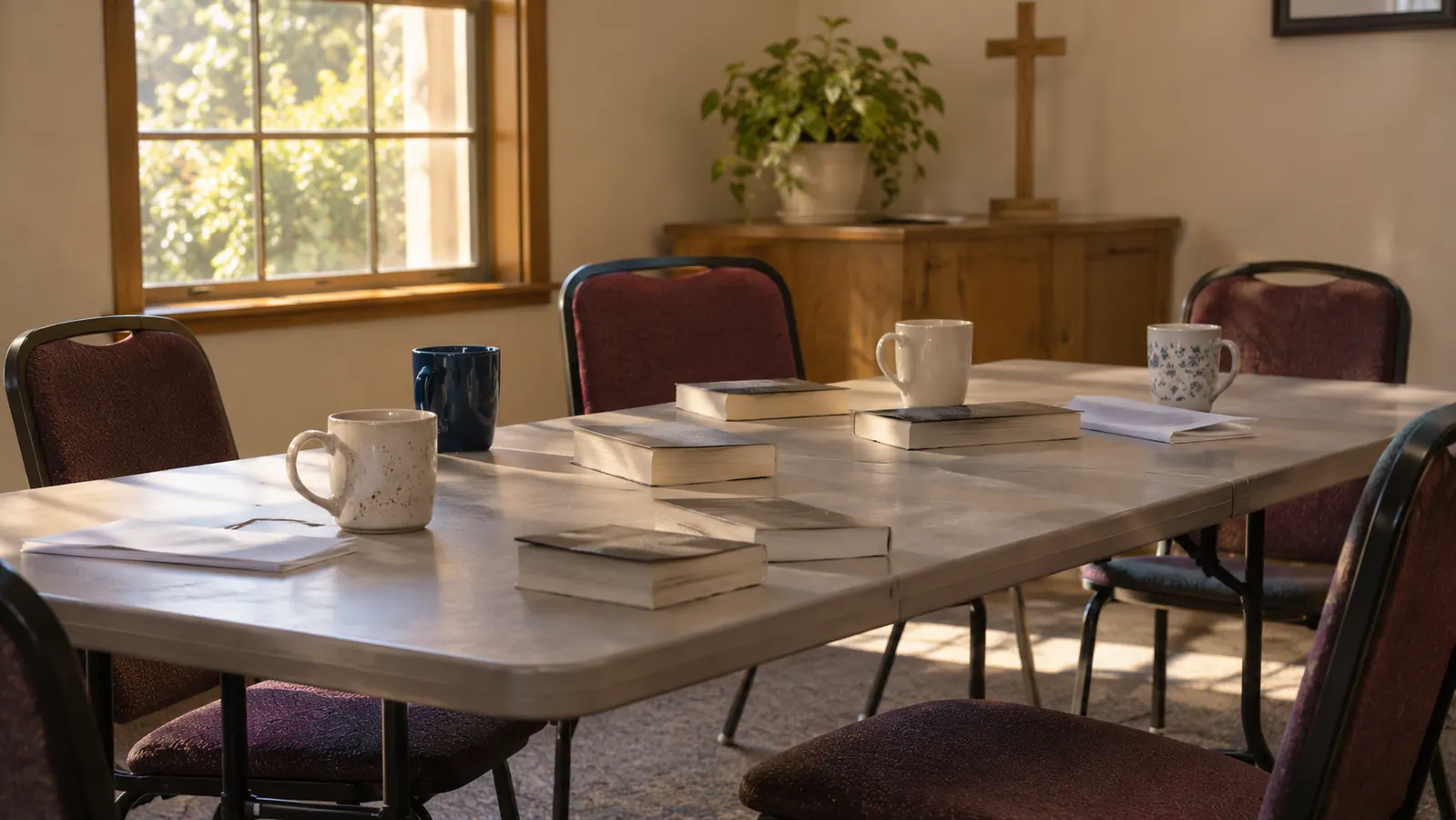
I picked it for October 2025, the second Tuesday, in the church fellowship room, eight of us around the tables with coffee cups and paperbacks. I chose this one knowing it was the longest book we had attempted together. That was a risk. Eight women in their sixties and seventies with three weeks of assigned reading can mutiny, and I have seen it happen.
Nobody mutinied. Eight of eight finished it, which has happened perhaps four times in all the years I have been choosing. Dottie, seventy-four and my longest reading friend, worked out the general shape of the ending early, as she always does, and was right in the broad strokes and wrong in the particulars. The discussion ran over. Two women said the Hollywood chapters were their favorite part because they remembered that era from the picture shows. One admitted she skipped a stretch in the middle, and I let it pass. It was one of our warmer meetings. I would pick it again.
What I Liked
- Long enough to let a life and its consequences actually play out, 480 pages in the Tyndale paperback
- Treats faith as part of the world rather than as a sermon dropped into the middle of a scene
- A standalone novel, so there is no series to chase and no book two to wait for
- Rivers writes small town and church people without faking them
- Clean without being childish, which is rarer than it ought to be
Where It Falls Short
- It takes real time. Three weeks for me at a normal pace, and the middle stretches
- The 1950s Hollywood chapters deal plainly with temptation and adult choices, so it is not one for a young teen
- It is not a mystery. Readers coming from suspense fiction will wait for a case that never arrives
- At 2.31 pounds and 5.9 by 8.8 inches it is a physical handful for older hands
Who This Is For
This is for a reader who wants a long, serious story about grace and consequences and can give it three weeks. It is for the woman who has read a shelf of suspense and wants one book with more weight to it. It is for a church book group that has run through the short ones. It is for anyone who loved Redeeming Love and wants another Rivers novel with the same willingness to look at hard things. And it is for the reader who wants a clean book that respects her intelligence, because this one does. If you would rather have the plain summary without my caveats, the straight review of this book is worth a look, and if you are weighing it against Redeeming Love, that comparison is here as well.
Who Should Skip It
Skip it if you want a mystery. Skip it if you read in twenty minute snatches and cannot carry a long book across two months. Skip it if the Hollywood chapters would trouble you, or if you are choosing for a young teenager, because I would not. Skip it if you want the faith thread front and center on every page rather than surfacing as the story allows. And skip it if long novels have disappointed you before by sagging in the middle, because this one sags a little, and I would rather tell you that myself than have you find it out on your own.
The One I Kept on the Hall Bookcase
Of the five novels I have held onto, this is the heaviest and the slowest, and the one I have thought about longest. If it sounds like your kind of book, the Tyndale paperback is the edition I read.
Amazon Check Today's Price on Amazon →