

Bridge to Haven took me three weeks, the longest any novel has held my green chair in years. I am sixty-six, a retired school librarian, and I read about one book every ten days, so three weeks tells you something before you ever open the cover. It tells you the book is long, and it tells you I did not want to skim it. Francine Rivers wrote 480 pages, and I read most of them after supper with a pencil in my hand, not marking the text, just noting on my page the day I started and the day I finished.
So let me answer the question I get at the church fellowship room table when someone spots it on the hall bookcase: is it worth the length. Yes, if you know what you are picking up. This is not a mystery, not a suspense novel, and not a short romance you finish in two evenings. It is a long story about a young woman, the people who owed her better, and what her choices cost her and everyone close to her. Rivers does not hurry that and she does not soften it. If you want a clean, quick whodunit, this is the wrong shelf. If you want a serious novel that takes sin and consequence as seriously as you do, keep reading.
The Quick Verdict
A long, serious novel about grace and consequence. Worth three weeks if you have three weeks, and not a book to hand a young teen.
Amazon Check Today's Price →Before You Give It Three Weeks, Read What the Listing Actually Promises
A standalone novel, not the first of a series, so the story closes where Rivers meant to close it. The Tyndale Fiction paperback runs 480 pages. Check the current listing for the edition you would be getting and what other readers said.
Amazon Check Today's Price on Amazon →How I've Used It
A novel is not a gadget, so how I have used it means how it sat in my week. Evenings after supper, mostly, in the green armchair by the front window with the floor lamp on and Glenn in the other chair with the television going. Sunday afternoons took a bigger bite. I keep one page in a small notebook for every book, and the page for this one says when I started, when I finished, and who I would hand it to. That last line took me a week to fill in.
Let me give you a plain picture of one week with it, because that is more honest than a word like absorbing. Monday through Thursday I read after supper, roughly seven o'clock until Glenn turns in around nine, and that is thirty pages on a good night, less on a bad one. Friday I did not open it at all. We had a funeral at church that afternoon and I came home wrung out and sat with the television instead. Saturday it rained, so I took the afternoon in the chair with the lamp on and read a long stretch, the kind where you look up and the light through the window has changed. That is how three weeks happens. Not in one sitting. In a good many small ones.
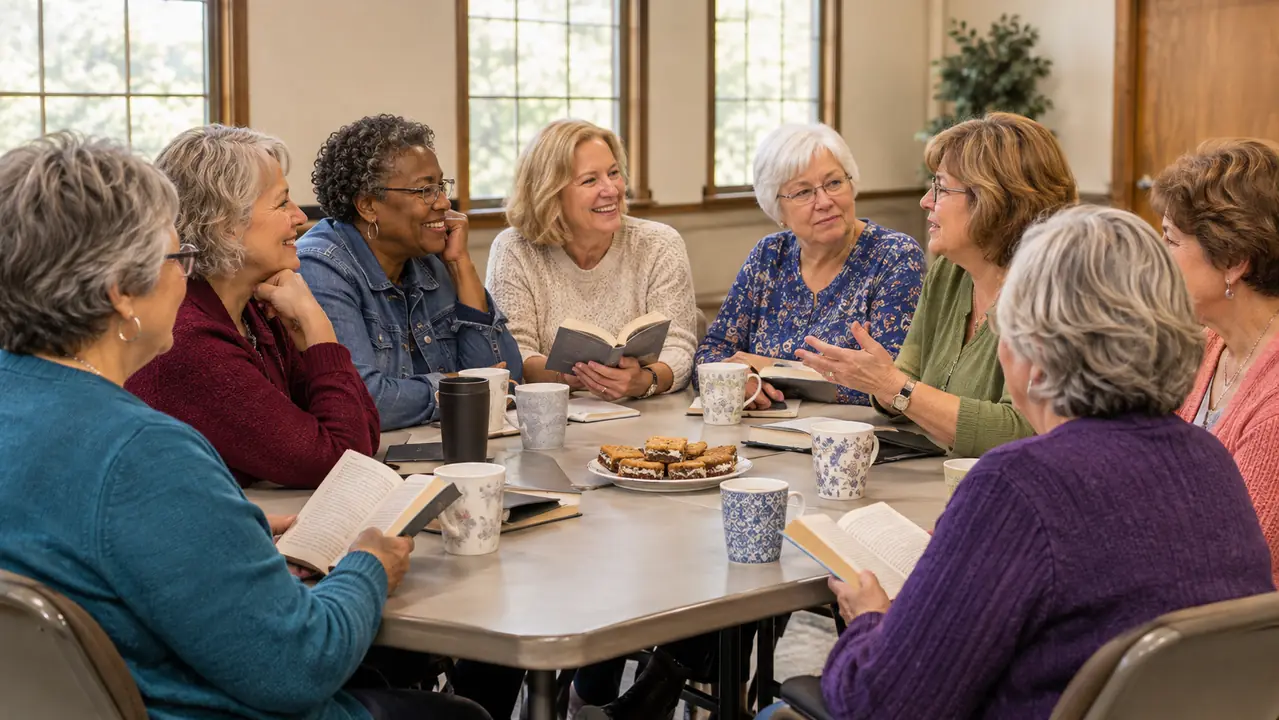
I chose it for our women's group at church, and we discussed it on the second Tuesday of October 2025, eight of us around the tables in the fellowship room with coffee and a plate of somebody's bars. It was my pick and I went in a little nervous, because a 480 page novel can leave half a room without a finish line. Nobody came unprepared. Everyone had something to say, which is not always true by October.
Since then the copy has gone out on loan once and come back with a bookmark still in it a couple of hundred pages in, which is about where a reader in a hurry stops. I understand it. This is not a book you carry in a tote bag to appointments.

What the Book Is About, as Far as I'll Say
I do not spoil books, so here is the listing's own description and nothing past it. You are given a young woman named Abra, who is known in the story as Lena Scott. You are given a pastor named Ezekiel Freeman, called Zeke, and his son Joshua. You are given two settings, the town of Haven and 1950s Hollywood. That is the frame. What happens inside it, who is faithful and who is not, and how it all comes out, is for you to find.
What I will say is that the two settings do the work you would hope. The Haven chapters and the Hollywood chapters are not interchangeable scenery. A reader carries one into the other, and I think that is the point of the book. Rivers is writing about a girl with two names and the question of which one she will be, and she lets the places argue with each other about it.
The other thing I will say is that the ending is not a trick played on you. It is earned. When I closed the book I sat a minute before I got up out of the chair, and that is my private measure of a novel. I do not apply it to everything I read.
What 480 Pages Feels Like, in the Hand and in the Week
The Tyndale Fiction paperback is listed at 5.9 by 1.3 by 8.8 inches and 2.31 pounds, and that weight is real. This is a lap book. It is not going in a purse, and it is not going to the doctor's waiting room unless you bring a tote. The edition I have is the reprint, in English, published April 2015. One copy, still on the hall bookcase, and it has held up to a lending and a meeting.
Because of the weight I read it propped on a small throw pillow on my knees rather than held up in the air, and that is not a complaint, it is a reading tip. The 1.3 inches of spine is what lets the book lie open flat on the pillow without your thumb doing all the work, which matters when you are two hundred pages in on a Thursday night and your hands are tired. A thinner book slides shut. This one sits.
Pace is where I have to be straight with you. The opening pulled me in and the last hundred and fifty pages went faster than the rest. The middle settles down. If you read forty or fifty pages a night, as I did, you will notice that settling and you will not mind it. If you read in ten minute grabs at stoplights, you will lose the thread and blame the book.
I will add one thing about that middle, because I noted it at the time. In the second week I went four days without reading and did not miss it, and I wrote that on my notebook page in plain words. Then I picked it up on a Sunday afternoon and read a hundred pages and did not want to stop. So the middle is not dull, it is unhurried, and unhurried is a different thing. The readers who quit on this book will quit in that middle stretch, and they will quit for a reason that has nothing to do with the writing.
That is the trade with a long novel. Rivers spends pages on a town, a family, and a girl growing up in them, and the spending is the reason the last chapters land the way they do. A shorter book would have been tidier, and it would have weighed less in the hand and less when I closed it.
Where It Asks Something of You
The Hollywood chapters deal with temptation and adult choices, and the book is honest about where those choices lead. I would not call it graphic. I would call it unflinching, and there is a difference. It stays clean enough that I was comfortable with it in a church group of women in their fifties, sixties and seventies, and I would still not hand it to a fourteen year old, and I would say the same to a grandmother buying for one.
Here is how I phrase it when somebody asks to borrow it, and I have been asked twice. I say, take it, and read the first sixty pages before you decide whether to keep going, and if you are thinking of passing it along to a young reader in your family, read the whole thing yourself first. That is not me being fussy. The book earns its adult material by being honest about it, and honest material is exactly the material a parent ought to vet before a teenager meets it on her own.
That is the one place I would push back on the cover copy if anyone asked me. A reader picks this up expecting a love story, and it is a love story, but it is also a book about a woman formed badly before she is formed well. Rivers does not skip the badly. Some readers will find that first stretch uncomfortable. I found it necessary, and I finished it.
If you have read Redeeming Love, you know the kind of ground Rivers covers. I read that one years ago, once, by myself, and the general shape of the reading experience is similar: a long story, a woman on a hard road, and a great deal of grace waiting at the end of it. I will not compare the two any closer than that here.
What Our Group Made of It
Our meeting filled its hour. Dottie, who is seventy-four and my longest reading friend, announced that she had known how it would end somewhere around page eighty. She had not known. She had guessed, and guessed early, which is her habit, and the rest of us were kind about it. What the group actually argued over was the middle of the book and whether the Hollywood chapters ran too long.
Two women said yes, too long. Four said no, that the length was the point. One admitted cheerfully that she had skimmed, and one said she had stopped a few hundred pages in and then started again from the beginning, which is a compliment in our group even when it does not sound like one. Nobody called it preachy. That is the word I listen for with a Christian novel, and it came up only as a note of relief.
We were half an hour into it before anyone mentioned the two settings, which surprised me, because that is what I wanted to talk about. Once it came up we stayed there a while, and the room split along the same line it always splits on, the readers who want a story to move and the readers who want a story to settle. The first sort were the ones who skimmed. The second sort were the ones who started over. Both sorts finished, and that is worth saying about a book this size.
I will tell you what I told them. This is not a book that will fix anything or settle anything for you, and I would not say that about any novel. It is a good long story by a writer who knows what she is doing with 480 pages.
What I Liked
- A standalone novel, so no waiting on a sequel to find out how it ends
- 480 pages of a story that uses the length rather than padding it
- Deals with temptation and consequence honestly without turning preachy
- Held up for a group of eight readers who found plenty to argue about
- The Tyndale Fiction paperback survived a lending and came back whole
Where It Falls Short
- Long. Three weeks for a reader who usually takes ten days
- The middle settles, and a hurried reader will feel it
- The Hollywood chapters are not for a young teen
- Not a mystery, so do not buy it hoping for a whodunit
- At 2.31 pounds it is a lap book, not a purse book
When I closed it I sat a minute before I got up out of the chair. That is my private measure of a novel.
Who This Is For
This is for the reader who wants a long, patient story and does not need a body in the first chapter. It is for the woman in a book group who wants a book that will hold an hour of conversation, which this one did. It is for anyone who read Redeeming Love years ago and has been waiting for Rivers to go that deep again. It is for a reader who likes a standalone, who wants to be finished when the last page is turned and not hunting for book two. And it is for the reader who does not mind a stretch of a novel that asks her to sit still, because the last third pays for the sitting.
Who Should Skip It
Skip it if you read for plot speed. If a book has to move on every page, this one will frustrate you by the middle. Skip it if you want a mystery, because there is no case here to solve and no culprit to catch. Skip it if you are buying for a young teenager, for the reasons I gave above, and do not let the cover talk you out of that. Skip it if the whole of what you want from a novel is a romance with a tidy bow, because Rivers makes her people work for what they get. And skip it if 480 pages is simply not a season of your life you have to give right now. It will keep.
If Three Weeks in a Green Chair Sounds Like Your Kind of Winter, Start Here
A standalone novel, 480 pages, Tyndale Fiction paperback. Read the listing, sample a page or two, and see whether Abra's story is one you want to give a season to.
Amazon Check Today's Price on Amazon →